
'Transforming' Conveyor System Helps Businesses Grow...And Grows Itself To Meet Changing Needs
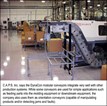
Portable and highly flexible, DynaCon "Truly Modular" conveyor system meets changing needs of growing businesses, providing dramatic improvements in uptime, agility and efficiency
There is a lot of planning required in growing a business...a lot of change, and more than enough risk. So, it's always gratifying when you can make a strategic decision that you don't have to continually rethink or repeatedly update.
In the material handling world, this certainly applies to conveyor systems. Integral to plant operations from production through order fulfillment, many companies are forced to make ongoing investments in conveyor systems, investments that hinder business growth by diverting capital, or slowing production, or causing downtime and expensive maintenance. In some cases, the conveyor boneyard is growing faster than the business.

"When you're growing fast and producing high volumes, you really need a conveyor system that's easy to work with and offers a great deal of flexibility," says Brett Huster, Engineering Manager with injection molder C.A.P.S. Inc. (Bridgeton, MO).
Today, many growing companies are eliminating that telltale boneyard by switching to a new paradigm in material handling technologies – the modular conveyor system. Still a new concept, the modular conveyor system is composed of highly interchangeable building-block units that can be readily configured and reconfigured in any length or shape that is needed.
"When you purchase a modular conveyor, you're actually buying a series of units to build a conveyor," says Huster. "It's up to the customer to decide on how you put them together. We use them in several different configurations, but also change them or move them whenever the need arises."
When companies plan for growth, they are usually planning for highly dynamic market conditions. On the production side, they must optimize various production operations – get lean, productive and agile. This requires that businesses, among other factors, get the right conveyor system.
Growth has always been an important objective for C.A.P.S. Inc. Since 1981, the company has grown from a one-machine start-up, to a multi-million dollar business. En route to that success, the company established remarkable standards for injection molding product development and quality. Those standards create an important niche for producing unique packaging components that solve tough packaging problems. Providing custom packaging components accounts for nearly 50% of C.A.P.S. Inc. sales.
Today the company produces about one billion caps and components annually for food, personal care, household products, medical, pharmaceutical and other applications, and is the largest producer of plastic grease caps in the industry. Customers include large and prestigious companies, including several household product packagers and Fortune 500 firms.
"We saw an important opportunity with the modular conveyor system about 10 years ago," Huster says. "The DynaCon line had just been introduced, and we really liked the interlocking design." Huster explains that the continual need for replacement and immobility of heavy, fixed-length metal conveyors were causing substantial replacement costs plus maintenance difficulties that sometimes slowed production. So, when he saw that modular conveyor system, he felt that it could help him overcome those problems and more.
Some customers compare that design to Lego interlocking building blocks. The modular conveyor system is composed of 3 ft sections that can be easily connected to any desired length. Radius-turn and ascending/descending sections are also available, allowing for freedom of configuration to route the conveyor over, under or around as desired. A wide assortment of accessories and control devices are available, ranging from in-line water baths to metal detectors.
"One of the things that we like best about the system is that you can reconfigure it so easily," Huster says. "Because you buy it in any number of sections you want, you won't outgrow the DynaCon system because it grows with you."
The operation today includes approximately 60 modular conveyor systems, which run between 1,000 and 1,200 linear feet, depending on changes to configurations. Total plant space for the C.A.P.S Inc. operation is approximately125,000 sq. ft and include 56 injection molding centers, six assembly machines, 12 closing machines and multiple robots, all designed to allow the streamlining of production processes through closing, stacking and packing.
"A lot of our parts are very small and thin-walled. With our old, fixed metal conveyors some of our products tended to get hung up in the flights or get pinched between the belts," Huster says. "We don't have that problem anymore because, with the modular conveyor, we can have tight tolerances by quickly changing the sides and flights anytime we want. We can also easily change belt styles to accommodate the parts we are running, which adds to throughput and productivity."
Added productivity means more controlled growth, leaner manufacturing rather than wasted resources and growing pains. Huster says that productivity via quick changeovers is made more efficient by the ease of storing conveyor sections and accessories.
Like other contract manufacturers, C.A.P.S. Inc. has the need to frequently change production runs. Modular conveyor systems can not only accommodate the changeover of production flow, but they can also be easily moved out of the way to facilitate the retooling of machines. C.A.P.S. Inc. has gone to great lengths to create a production process that is both efficient and cost-effective, producing the best possible injection molded components at the best price.
"Our modular conveyor system grows right along with our business because it works on every product we make. It is very easy to add and remove sections and accessories as needed, such as extended sides and cooling fans. If we decide to run two machines into one conveyor system, I can extend the length of the conveyor easily. Everything is easy. Whatever the situation calls for, there is usually a very easy way to do it," he explains.
"The lightweight construction of our conveyors is a big deal. Anyone who works for us can handle one of these conveyors with no physical risk," says Huster. "Our floor is a vinyl tile floor, and we do a lot of cleaning - sweeping and mopping. These conveyors make it extremely easy to move out of the way. They don't damage the floor. We just keep moving them around as needed. And that keeps production moving, too."
Although light in weight, DynaCon conveyors and accessories are durable, made of tough, impact-resistant plastic. Huster refers to them as "maintenance-free" because even if a conveyor section happens to be damaged in some accident, it's quite easy to replace any of the units from their inventory or to get overnight delivery of any components they might not have on hand.
Huster says that after-sale support from Dynamic Conveyor (Muskegon, MI), the DynaCon manufacturer, is first rate. "They really stand behind their product," he explains. "That is getting to be harder to find in this day of outsourcing. A lot of vendors will eventually address a problem, but in many cases all they are doing is selling you the parts they should have sold you in the first place. Dynamic Conveyor has been extremely responsive in taking care of the few problems we've had, and have been very fair about it. I deal with 300-400 vendors each year, and they are within the top five every year. That level of support has helped us sustain our rapid growth."
Huster adds that his modular conveyors integrate very well with his other production systems. While some conveyors are used for simple applications such as feeding parts into the molding equipment or downstream equipment, he also uses them as orientation conveyors (capable of manipulating products and/or detecting jams and faults).
The resulting efficiency and dependable performance has contributed significantly to the reduction of the ratio of scheduled maintenance work hours compared to emergency maintenance work hours, which have been reduced from 1:1 to 15:1. Through this overall program, C.A.P.S. Inc. has lowered downtime and increased safety while also making gains in quality and customer satisfaction.
"We are a modular conveyor house now, Huster says. "As we grow, our conveyor system grows, but in an efficient, flexible and organic way. The conveyor boneyard is gone, a thing of the past."
Ed Sullivan is a technology writer based in Hermosa Beach, California.