
Intelligent Packaging Central Component of 'Future Smart Kitchen'
By Kit L. Yam, Ph.D., Department of Food Science, Rutgers University
Table of Contents
Introduction
Intelligent Packaging
Future Smart Kitchen
Case Study: Intelligent Cooking
Introduction
Intelligent packaging and the "future smart kitchen" are concepts that are likely to play an increasingly important role in providing consumers higher food quality, better convenience and improved safety when cooking packaged foods in a microwave/convective oven. This article provides an overview of these state-of-the-art concepts along with a case study involving "intelligent cooking" to illustrate how such a system will work.
Intelligent Packaging
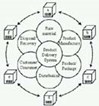
The traditional functions of packaging are well established. They consist of containing the product, protecting the product, providing convenience and conveying product information. Recently, a research group at Rutgers' Department of Food Science introduced the concept of using the package as an intelligent messenger.1,2 Since the package, in one form or another, is involved in every phase of the product delivery system — from raw material through manufacture, packaging, distribution, consumer use and recovery of materials, as shown in Figure 1 — it is in a unique position to carry and deliver vital information necessary for making intelligent decisions that can lead to greater product value.

The communication function of the package is currently being used for such purposes as advertising and displaying product information. This is accomplished primarily through written words or graphics, and mostly in the retail area. In addition, packaging is being used to provide coded information (i.e., UPC symbol) to improve the transfer of information in distribution, inventory control, retail sales, etc.
However, the communication function of the package can be significantly enhanced to facilitate information gathering and sharing and, in some cases, even for information processing to achieve greater product value.
The term "intelligent packaging" emphasizes the role of the package as an intelligent messenger or information link in today's Information Age. The concept of "intelligent packaging" is a central component in the future of the so-called "smart kitchen."
Future Smart Kitchen
The Rutgers research group has been working with Samsung Electronics and Symbol Technologies (Holtsville, NY) to develop the technologies for the future smart kitchen. The development involves integrating food science, packaging technology and information technology to provide consumers with higher food quality, better convenience and more safety. In the smart kitchen depicted within the dashed rectangle in Figure 2, appliances such as the microwave/convective oven, range, refrigerator and dishwasher are networked to easy-to-use computer hardware and software (data processing, scanning, voice recognition and internet connection).
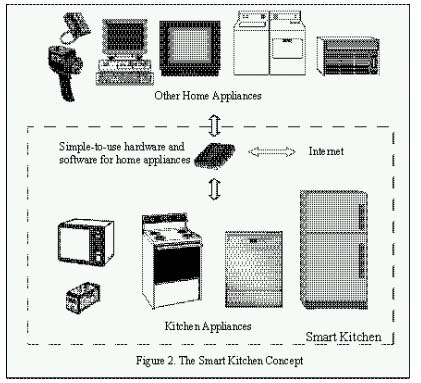
Although the primary purpose of the smart kitchen is food preparation, the smart kitchen also enables the consumer to perform such additional tasks as monitoring food inventory, grocery shopping online, obtaining online information about weather and road conditions, sending messages via the internet, and so on. The smart kitchen is also networked to non-kitchen appliances, including the computer, television, video surveillance, phone, air conditioner, heater, washer, dryer, water meter, etc., and thus can become a convenient, centralized location where the consumer manages household activities. Since the smart kitchen is designed for everyone in the household to use, including people with little or no computer skills, the hardware and software must be easy to learn and use.
Case Study: Intelligent Cooking
To illustrate the role of intelligent packaging in the smart kitchen, consider the intelligent cooking appliance system3 shown in Figure 3. The system consists of a convective/microwave oven with a built-in microprocessor, a bar code scanner and an optional voice recognition device and is connected to a touchscreen and the internet. The microprocessor contains information about the oven characteristics and the algorithms for data processing. The package serves as an intelligent messenger that carries vital information about the food and the package through a printed bar code. Information sharing takes place when the bar code is scanned, and then the scanner transmits the information to the microprocessor, which in turn controls the magnetron, heating element and turntable in the oven.
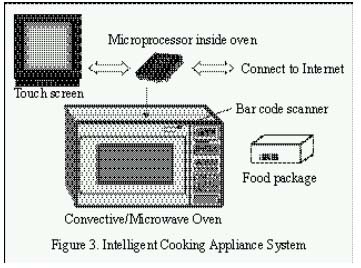
The system provides the consumer with higher food quality by overcoming some major problems in cooking packaged foods. Problems arise due to different ovens having different heating characteristics, different foods having different dielectric and thermal properties, and different packages having different sizes and shapes. Thus, cooking packaged foods in a conventional oven often does not provide optimum results. The intelligent cooking system overcomes this problem by enabling the oven via the scanning process to identify the food and the package and to perform optimum cooking.
Another problem occurs if the consumer is dissatisfied with the cooking instructions provided by the food manufacturer. In this case, the consumer can interact with the system via touchscreen or voice recognition, and the microprocessor then modifies the cooking instructions based on its algorithms, asks the consumer for feedback and stores the information in the database for future use.
The intelligent cooking system also provides the consumer with convenience in a variety of ways. It eliminates reading the cooking instructions, which is particularly useful for people who have difficulty seeing and for those who speak different languages. The system provides an easy, accurate way to optimally control the operations of the oven, which is especially useful for multi-step microwave/convective cooking. The system provides the convenience of monitoring food inventory, online shopping, downloading cooking instructions, accessing information such as nutrition, etc.
The system also provides the consumer with enhanched food safety in a number of ways. It alerts the consumer of product recalls by food manufacturers. It also alerts the consumer of food allergens, which is critical for people with life-threatening food allergies. In addition, a time-temperature indicator (TTI) can be integrated into the bar code to enable the system to determine the quality and safety of the food package. Moreover, food manufacturers can produce video clips about safety in food handling, place them on the internet and allow the consumer to access them using the system.
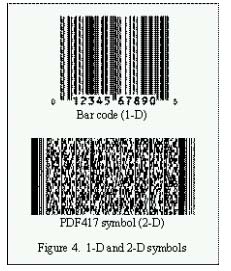
Finally, the package performs the function of carrying and delivering vital information; it must have an information device such as a bar code, TTI or a sensor. Since the bar code contains very limited data, the PDF (Portable Data File) symbol is more suitable. The PDF417 is a two-dimensional symbol (see Figure 4) that carries up to 1.1 kilobytes of data for text, numbers and graphics.
The food scientist, packaging engineer and oven manufacturer must work together to determine the information to place on the information device. The Rutgers research group is working with companies on package design, optimum cooking instructions, database (for nutrition, allergens, ingredients), scanning technology and web technology.
References
1 Yam, K. L. and R.G. Saba, 1997, "Intelligent Product Delivery Systems: A New Paradigm for Packaging," Future-Pak '97 Conference Proceedings, George O. Schroeder Associate Inc., Appleton, WI.
2 Yam, K.L. and R.G. Saba, 1998, "Intelligent Product Delivery System: Paradigm Shift in Packaging," Packaging Technology & Engineering, 7(3): 22-26.
3 "Intelligent Microwave Ovens Would ‘Zap' Food to Perfection," New York Times (June 9, 1999).
About the Author: Kit L. Yam is associate professor in the Department of Food Science, Rutgers University. He also holds two professorships overseas and serves on the editorial boards for two peer-reviewed journals. He was chairman for Scientific Development for the Research and Development Associates for Military Food and Packaging Systems and has published more than 80 technical papers. He can be reached by email at yam@aesop.rutgers.edu)