
EMERGING TECHNOLOGIES: Shelf-stable meals on the rise?

By Steve Mogensen, Allied Development Corp.

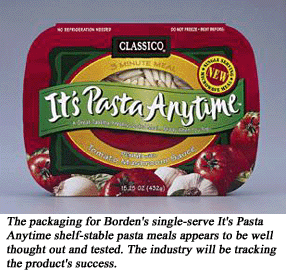
In June, Borden Foods Corp. (Columbus, Ohio) introduced what it claims is the first-ever, shelf-stable pasta meal offering the taste and texture of pasta prepared from scratch to the consumer marketplace. According to Lynn Anderson, communications director for Borden Foods, "Sales of the four Classico meals called It's Pasta Anytime are increasing and distribution is broadening."
The introduction and early success of this product raises the question: Are shelf-stable meals an indicator of things to come or just another short-lived new product introduction?
Filling a need
According to Rod Simpson, associate director of package engineering, Borden Foods' development work started because of its strong belief that a shelf-stable pasta product is needed in the marketplace. Borden Foods began its research several years ago with the following vision for their product:
The process to make a pasta meal at home is lengthy. If the time to heat up the water is included, cooking a pasta meal takes well over a half-hour and can approach an hour. This amount of time is often not available to consumers, many of whom maintain very hectic schedules. Borden Foods determined that a pasta meal which took only a few minutes was needed.
Existing refrigerated and frozen meals provide greater convenience than cooking from scratch, but other qualities of a pasta meal are extremely important. Texture is critical for the pasta itself, and a fresh taste is highly desired. Existing refrigerated and frozen pasta meals were believed to lack the desired texture or fresh taste or both. Frozen pasta meals were also prone to uneven heating using the microwave. The new meal, Borden maintained, must provide improved texture, taste and preparation consistency.
Borden Foods followed through with several years of effort to develop the product, procedures and packaging to fulfill its vision of a shelf-stable pasta product. This included a great deal of consumer testing along the way.
Thermal filling process
First, the product must be processed to be shelf-stable:
The product in this application is divided into two components — the pasta and the sauce. While both require special processing to create a shelf-stable packaged product, Simpson says that the pasta is packaged using a proprietary thermal filling process. This, he asserts, is a key to the It's Pasta Anytime product.
The sauce, meanwhile, is packaged using more standard "hot filling" techniques and is the less difficult of the two filling processes. Both filling processes are regulated and accepted by the FDA.
The packaging includes a number of key characteristics: The pasta and sauce are each packaged in their own clear pouch. Each pouch must provide a high barrier to oxygen, which is required to create the desired shelf-life, which in the case of It's Pasta Anytime is six months. A layer of EVOH is used as part of a multilayer film laminate to provide the needed barrier for the pouches. In addition, the pouches each contain easy open features and are individually dated.
The pouches are then placed in a polypropylene tray with a polyester lid film. The lid film is designed to serve several purposes:
• To keep the tray clean during distribution, as the tray will ultimately be the cooking container.
• To create a peelable lid that is consumer-friendly.
• To be used as a splatter shield during cooking. The film is designed to be curl-free in order to meet this requirement.
Creative tray
In addition to becoming the cooking and serving container, the polypropylene tray also provides a variety of special features. For example, the bottom of the tray is domed towards the inside, creating slightly less thickness in the center of the tray. This assists with even heating. Thus, the center of the meal will be heated as quickly as the outside because the center is thinner.
The doming of the bottom also centers the weight of the final package configuration so it will stand properly on the shelf. The package is positioned on the retail shelf on its side to ensure the top of the package is facing the consumer.
Other features of the tray include its special green color, which is thought to be preferred based on extensive consumer testing. The tray also includes locking tabs to prevent the outer sleeve from being displaced once it is slid into position on the tray.
The final packaging item is the outer sleeve. This paperboard sleeve includes printed graphics and a clear window so the consumer can see the pasta and sauce through the window and through the clear pouches. The sleeve includes a tab that creates part of the base which allows the package to be displayed resting on its side.
Single servings are key
The above description of the It's Pasta Anytime package details many of its important design features. The package, which appears to be well thought out and tested, is a key element to this innovative food product. But there is one final point that is essential to the genesis of the It's Pasta Anytime product line. This involves the procedure to package the product in appropriate portions for single servings.
According to Anderson, several years ago Borden was already providing a shelf-stable pasta product for the foodservice market. This product is still marketed by Borden today under the R&F No Cook brand name, and the cooked pasta is normally packaged in a 5-lb bag. "It is an understatement to say pasta is very sticky and difficult to handle when cooked," says Simpson, "so it was a major breakthrough for Borden to develop the procedures to package pasta in 9-oz pouches, as required for the Classico product line."
Packaging is more than just materials, and the development of the Classico product is an example of how the process of getting the product into the package is a critical packaging function. Nonetheless, consumers will not be evaluating clever packaging processing that they will never see. To the contrary, the consumer will try the product based on its shelf appeal (with a little help from advertising, promotion, etc.) and will judge the product on its convenience to prepare and, perhaps most importantly, its taste.
The consumers' final choice in this regard is expressed in product purchases, and the packaging industry will watch for their opinion. A success for It's Pasta Anytime will definitely motivate others to join the shelf-stable-meal fray.
For more information: Borden Foods Corp., Rod Simpson or Lynn Anderson, Tel: 615-225-4000, Email: Landerson@bordenfoods.com or Rsimpson@bordenfoods.com
About the Author: Steve Mogensen is vice president of sales and marketing for Allied Development Corp., a Lakeville, MN, company that provides a variety of services to the packaging industry aimed at helping companies improve their revenue. Mr. Mogensen joined the startup company in 1996 after more than 20 years experience as a business and technology executive for Viskase Corp., Rexam PLC and the Graphic Packaging Division of ACX Technologies Inc. A Registered Professional Engineer, Mr. Mogensen has a B.S. in Engineering from the University of Illinois and an MBA from the University of Chicago/Lewis University.
Mr. Mogensen can be reached at: Allied Development Corp., 17689 Lake Oak Circle, Lakeville, MN 55044, Tel: 952-898-1832, Fax: 952-898-2242, Email: sam@allied-dev.com, Website: www.allied-dev.com.
Editor's Note: Steve Mogensen's "Emerging Technologies" column appears each month at PackagingNetwork.com.