
Avoiding The Migration Of Packaging Components Into Food: Evaluating The Obstacles
The National Food Laboratory
A revolution is occurring in the food packaging industry. According to a recent survey by Hunt's, a ConAgra Foods Company, 56 percent of consumers have purchased a product they would not normally have purchased because of "exciting new packaging." But this requires new technology. And with any new technology comes new challenges - especially with the variety of foods and package interfaces now possible. Today, one of the major concerns when considering packaging, especially paper or plastic, is whether any component of a package will migrate into food or whether flavors, colors or ingredients will be scalped into the packaging material. Food safety and marketing professionals both have concerns about the safety of the packaged food, as well as the appearance, flavor, odor and other factors affecting consumer appeal.

While consumer appeal will determine the success or failure of a given product, an unsafe container is a public health and liability issue. Thus, packaging professionals must be aware of the potential for migration of packaging components, as well as the regulations governing this area.
Getting FDA Clearance
Food safety professionals should ask whether the desired packaging material has been cleared by the FDA for use in contact with food. This applies to any packaging component which may potentially affect food quality. It's not just the container, but also the printing inks, labels, closures, adhesives, and seals. Packagers should insist that their packaging material suppliers demonstrate compliance with the appropriate regulations via a letter or other documentation. Periodic quality testing of compliance will ensure embarrassing questions won't be raised down the road. Now you're ready to package.
Let's take a look at the regulations and how they apply to food safety. Title 21 (Food and Drugs) of the Code of Federal Regulations addresses this issue. Every food packaging professional should have Parts 170 to 199 of this regulation on their bookshelf. In them are lists of substances cleared for food contact use.
The lists are grouped into parts (chapters) according to type of material such as adhesives and coatings (Part 175), paper and paperboard components (Part 176), and polymers (Part 177). In each part, material specifications are tabulated, and by reading the fine print, you can determine if your packaging material is listed. If it is, you're free to use it under the use conditions summarized. One or more tests are then described that a company or their independent laboratory should use to occasionally test and ensure that a supplier delivers compliant material.
These tests are usually extraction or solubility tests. That is, depending on the food type to be packaged and the temperature under which it will be used, the packaging material is heated in a solvent for a specified time and temperature. The solvent is analyzed for extracted components, which simulates the most extreme conditions to which the packaging will be subjected. Your goal is to ensure that harmful compounds are not extracted into the food under actual use.
Because solvents present fewer problems in the analytical laboratory, they are generally used in food package extraction testing instead of actual foods. Since the solvents simulate the action of foods on the packaging, they are called food-simulating solvents. For example, dilute aqueous ethanol simulates the action of aqueous, acidic or low-alcohol foods while heptane may be used for fatty foods.
To find the detailed test conditions, you must know the food type to be packaged and the most extreme heat conditions to which it will be subjected. The FDA classifies foods into nine types depending on the amount of acid, alcohol or fat they contain. These types, labeled I - IX, are fully defined in 21 CFR Part 176.170. Temperature conditions are divided into the so-called Conditions of Use, also defined in the CFR. These include high temperature, heat sterilized use (over 212 °F), hot filled or pasteurized use (above or below 150 °F), and room temperature, refrigerated, or frozen use. Understanding your Food Type and Condition of Use enables you to choose the proper extraction test conditions.
How an Independent Testing Lab can Help
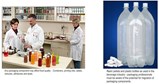
Many companies will want to have an independent testing laboratory like The National Food Laboratory (The NFL) perform these compliance tests for them. This eliminates the need for an expensive in-house testing facility with its specially trained and equipped staff. Additionally contract laboratories provide reassurance through third party checks of packaging materials for quality.
For example, recently Grimmway Farms in Bakersfield, California wanted to test each of their plastic packaging film suppliers for FDA compliance. As the world's largest producer of fresh carrots, this grower packages its carrots for the fresh produce market. Packaging is vital in assuring the quality of their product. Patrick Kelly, Director of Quality Assurance, approached The NFL and asked that the films be tested for compliance with the relevant part of 21 CFR. Quick testing indicated full regulatory compliance, thus assuring that the carrots were not adulterated by packaging components.
But what if a component of a packaging material isn't listed in the CFR? Perhaps a pigment manufacturer wants to market a bright yellow pigment for use in beverage bottles? 21 CFR 178.3297 lists all approved colorants for polymers. If this yellow pigment isn't listed, it's not approved, and it can't be used until it is. Or maybe a new resin is available for making these bottles? Only the polymers listed in 21 CFR 177 can be used in food contact applications unless FDA approval is obtained.
The Need for Food Contact Notification
To get approval, the producer has to jump through a set of hoops called Food Contact Notification (FCN). Prior to January 2000, FDA clearance of a new food-contact material required the preparation of a Food Additive Petition or a Threshold of Regulation request. These expensive procedures sometimes took years to clear the FDA.
The FCN procedure has streamlined the clearance process considerably. Among other things, the notifier presents data to the FDA on the potential migration of the component into foods. If the FDA does not object within 120 days to the use of the substance, based on safety grounds, it may be marketed immediately.
What kind of migration data is needed? Again, it's related to the Food Type and the Condition of Use. And again for ease of analysis, food-simulating solvents are generally used instead of actual foods. For example, migration into aqueous, acidic and low-alcohol foods is generally evaluated using 10% ethanol.
Migration into fatty food frequently requires evaluation with a food oil. Heptane, used in CFR testing, may over-estimate migration and is generally avoided. Miglyol, a fractionated coconut oil, is often used to satisfy FDA requirements while the European countries require olive oil. Analyzing for packaging migrants in food oil can present formidable analytical difficulties, so 50% or 95% ethanol can sometimes be substituted.
Tests must be performed in triplicate. The test material is immersed in the solvent and heated using a given temperature regime which depends on the Condition of Use. For example, one extreme condition requires heating at 250°F for two hours followed by 10 days at 104°F. Since this is above the boiling point of most food-simulating solvents, special cells are used which are designed to withstand the extremes of temperature and pressure that are encountered.
Some cells are constructed so that only glass and Teflon contact the solvent, while others may be all stainless steel. The cells are also configured so that all surfaces of the test material can contact the solvent or, in the case of a coating, only one side of a test plaque will be extracted. For safety, cells are then placed in a high-pressure vessel for heating.
The NFL uses a steam retort in its pilot plant. Retorting over-pressures the cells, thereby preventing leaking. At various intervals during the testing period, the solvent is sampled and the migrating component is analyzed. Of course, no migration is best, as this is the simplest regulatory situation. However, if migration is found, the safety of the migrant must be evaluated, taking into consideration the amount found and other factors.
Here again the independent testing laboratory becomes a valuable partner in obtaining FDA clearance for the new packaging component. Analytical chemists trained in the use of gas chromatography, high-pressure liquid chromatography, and mass spectrometry most often apply these techniques to the analysis of the extracts.
When the packaging material contains a metal which may migrate, for example in a new colorant, then the laboratory will need atomic absorption spectrometry or inductively coupled plasma spectrometry. Each analytical method must be capable of reaching the required detection limit, typically 50 ppb (parts per billon) or less. A well-equipped laboratory like The NFL can choose the proper analytical technique to solve analytical problems, which may, and frequently do, arise during migration testing.
The FDA won't take the word of an analytical laboratory that the methodology used is suitable and able to deliver the correct result. A Food Contact Notification requires that each analytical method be validated. Extracts of samples or controls must be spiked with the potential migrant at known levels and then analyzed using the same method used for the sample extracts. Adequate recovery of the spiked material proves that the method works as reported.
Food Contact Notification can be a time-consuming process. What if a producer goes through all this trouble and finds that the migration rate is too great? The new packaging material will have to be reformulated and retested - another expenditure of time and dollars. The staff at an independent laboratory can help design exploratory tests to point the developer of a food contact substance in the right direction and lessen the chance that a costly migration study will have to be repeated.
Preparing for the Future in Packaging
The food industry continues to be presented with new packaging, ingredient, and processing options as consumers search for better tasting, low preparation foods. With the proliferation of options comes the difficulty of keeping up with all the factors that affect the safety of the products you sell. Therefore, to remain competitive with new and novel products, it's essential to identify and establish relationships with packaging experts such as The NFL, who can guide you through the ever-changing minefield of regulations and testing technology.
For more information about solving packaging-related problems, such as the migration of packaging related components into food, please email Bob Bussey at BusseyR@TheNFL.com; write to The NFL at 6363 Clark Ave., Dublin, CA 94568; or visit them on the Web at www.TheNFL.com.